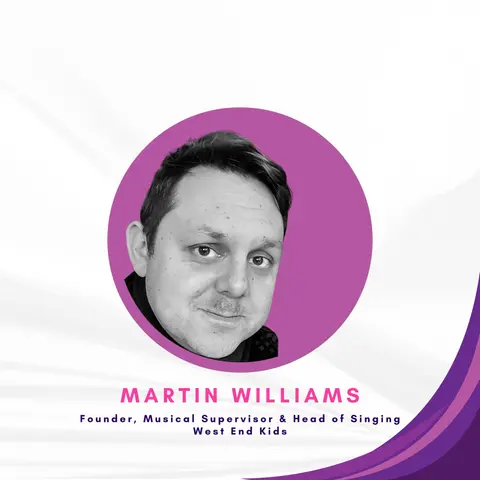
In depth with Martin Williams – Founder, Musical Supervisor & Head of Singing, West End Kids Troupe
In depth with Martin Williams – Founder, Musical Supervisor & Head of Singing, West End Kids Troupe
How old are you?
Don’t be cheeky. I’m the wrong side of 30 but the right side of 50.
Where are you from?
I’m from Wrexham in North Wales.
Journey with West End Kids:
When did you create West End Kids?
I created West End Kids in September 2001, as it happened, it fell right around the weekend of 9/11, for those old enough to remember. Our first rehearsal was at the Blue Elephant Theatre in London.
What inspired you to start West End Kids?
There were a couple of things that led to the creation of West End Kids. The main catalyst was probably my frustration on behalf of some students I was teaching at other establishments. They were super motivated and interested, but were held back by others who were just there to give their parents a few hours of peace and quiet. I decided I wanted to create something specifically for those performers—to push and challenge them in line with their motivation and talents. So, I did!
Performance Highlights:
What has been your favourite performance so far and why?
I know it’s a cop-out, but I can’t possibly choose just one. A quick tot-up would be around 966 separate songs (as of August 2024) that I’ve arranged, directed, and performed with West End Kids. Troupe performances tend to age and settle on me, and after 6 months to a year, I usually land on a long term view or memory. My top performances give me goosebumps whenever I watch them back, and I never tire of revisiting them. I can, however, give you a top 4 – in no particular order!
-
Sing – (Summer 2023, CarFest)
I’ve written thousands of musical arrangements for West End Kids over the decades, and I think this one was probably the best in terms of audience reaction. Wherever we performed it, the audience was completely swept up. The Troupe loved performing it, and they did a fantastic job, if I do say so myself. We had a really strong lead in Emma Brazil, whom I’d worked hard with as a private student and it was great to see her progression. -
Chaplin – (Winter 2013 and Summer 2016, West End LIVE)
Personally, one of my favourite musicals, so I’m always going to have a soft spot for it. We had special permission from the composer, Chris Curtis, to represent the show at West End LIVE in 2016, which was special. Adam Dance, who played Chaplin, did a brilliant job, and the music is just perfect. -
Who Will Buy – (Spring 2022, Move IT)
This one was special for a few reasons. My mentors were Lionel Bart’s (composer of Oliver!) musical assistants, so performing one of his pieces at Move IT was a real honour. I was also thrilled with the overall production—the ladders were my favourite addition! We aimed to try and recreate the spectacle of the movie with no set (!), and considering the constraints of youth theatre, especially at Move IT, I think we did a great job—especially the ending with the band and the movement towards the audience, which was always my vision for the number. -
Jerry’s Kids (Summer 2015, West End LIVE)
There are so many little moments in this performance that give me goosebumps still – even watching it back 9 years later. I loved it
Honourable mentions go to:
- Our Fave Son (Spring 2015)
- Addams Family (Summer 2018)
- 76 Trombones (Spring 2019)
- Six (Summer 2021)
- Elton John (Summer 2024)
Can you share a memorable moment from one of your performances?
I’ll never forget a young lady—no names, I won’t embarrass her (though she’d be in her 30s now!). She must have been about 10 years old when she fell clean off the front of the stage at Leicester Square during one of our first-ever public performances. She passed out and just went straight over the edge! Thankfully, her mum was the Head Chaperone!
I also find myself holding on to micro-moments within performances, and they are very niche! Here are a few bizarre examples that stick with me for some odd reason:
- Tanya Bailey adjusting her vocal technique midway through a particularly long note in Hello Dolly at West End LIVE to get her to the end in front of 30,000 people.
- Olivia Gavigan busting out perfectly polished choreography in a section we had worked tirelessly on in 76 Trombones at Move IT 2019.
- Achieving the skipping rope (skapping) section in Shaking The Blues Away and nailing it live virtually every time. We did it in 2017 and 2022
- Tilly Wolstenholme hitting a top B live (in whistle!) in O Holy Night at Ideal Home Show. When she started lessons with me, she couldn’t sing above a middle A due to nodules.
- Bethany Lisher absolutely beasting through the pain barrier in dance rehearsals for Swing before West End LIVE 2014. She was the toughest cookie and most determined I’ve ever taught.
- Holly Hull landing Christine in Phantom (London). I had previously insisted we needed to work extensively on her legit voice as a child, as that was where her future was—even though she hated legit!
There are many more micro moments. I find myself being drawn to the moments within songs rather than whole performances. Far too many to list them all!
Can you share your pet hates?
Eesh, I have a fair few, and over 25 years at West End Kids—I reckon I’ve seen it all. I’ll give you another top 3!
- Disloyalty—in the context of taking absolutely everything they can from you and then not thinking twice before either stabbing you in the back or leaving you high and dry.
- Ingratitude. Don’t get me wrong, nobody is suggesting people open a temple—but if you’ve hoisted people up by their bootstraps to do things they wouldn’t have been capable of, I think it’s common courtesy to show a bit of gratitude. Without becoming too philosophical about it, I think the nature of what we do at West End Kids is extremely demanding and intensive, and there is quite a lot of ‘tough love’ involved. I have always tried—and been proud—to give students what they need, not necessarily what they want. It takes a deeper level of insight to be grateful for tough training.
- Parents who think they know better—I’m sure all in a similar job to me will sympathise with this one. I’ll leave it there!
Who are your biggest inspirations?
- Leonard Bernstein: He once said, “You have to suffer this man’s standards because that’s what we’re learning.” An absolute maestro relentlessly driven by standards and by serving the craft above and beyond all else.
- Jerry Herman, Lionel Bart, David Shire: My favourite composers. When I was/am in need of a lift or pick-me-up, I’ll always turn to these guys!
Do you follow the lives / careers of former students?
Yes, where possible. To be frank, I’m a deeply introverted and very anti-social person (!). I find people, generally speaking, difficult. So you won’t very often find me cooing at performances, attending opening nights or hanging around at stage door, but I am always looking on with pride! Not just the famous ones though, I follow everyone – not just people who decided to perform professionally. I have a deep respect for all those who have dedicated themselves to their craft through West End Kids, even the ones I’ve fallen out with over the years, of which there are a few! It is hard. It takes grit, determination, ambition, motivation and dedication to do it and these are all qualities that I not only try to teach, but hold in the highest regard. I enjoy following the things they’ve learned at WEK progress into their adult lives.
Did you ever want to be a performer?
I was a child actor and did the rounds in the soaps, adverts and musicals etc when I was very young, but it never really appealed to me as I got older. I found that I much preferred and was excited by being behind the piano rather than being in front of it. There was a period where I was wondering about getting an agent and entering the scrum to be a West End MD or Orchestrator / Arranger etc, but to be honest – I really don’t like that the creative team element of the industry is much more about networking and being nice to the right people rather than a meritocracy, so I decided it would make me miserable.
What would you say are your biggest talents?
I would say that I have very little by way of natural talent. Anything I’ve done in my life has been through sheer hard work, persistence and determination. I don’t mind telling you that I had a very unpleasant and difficult childhood in a tough working class town and left home for London on my own, at the age of 11. I learned that if you were prepared to sacrifice, be the hardest worker in the room and push yourself that half yard further than anyone else was willing to do, then you could do well. That is what I teach to all of my students – and my own children. Most parents would be familiar with the expression ‘school of lifer’ – and that is me in a nutshell. I left school at 15 with virtually no qualifications aside from various music bits and pieces. If you have buckets of natural talent to boot, then great (go you!) – but the work ethic is what counts above and beyond all else. We audition potential West End Kids on heart rather than ability and then back ourselves to teach the rest.
West End Kids is known for its rigorous training and high standards, which some might say are too tough for young performers. How do you see your role in balancing those demands with the well-being of your students?
Long answer incoming! 🚨
Some people might say that West End Kids is too hard, and I can understand why. The work and effort required is intense, and it’s designed that way for a reason. My role has always been twofold: to elevate those who have the capacity for what is an extremely demanding industry, and to help others realise that perhaps this path isn’t the right fit for them. This is where tough love comes in. I don’t expect anyone to be grateful for holding up a mirror that reflects this industry might not be right for them. I understand that some will feel bitter and resentful. While we don’t dictate the industry’s demands, our goal is to equip students with the resilience and skills to thrive in it. And performing arts isn’t the only demanding field by any stretch of the imagination. Elite anything takes mental toughness, and some people simply aren’t cut out for it. When that truth becomes clear, it’s natural that some won’t like it. But I know that the majority come to appreciate it in the long run.
Our parent feedback shows that one of the main reasons parents send their kids to West End Kids is to explore whether this is a viable, long-term career path—before remortgaging the house to spend £40,000 on university tuition fees. As a parent myself, I know I’d rather find out if my teenager has what it takes to stick with it before forking out that kind of money. If a performer finds the work ethic required at West End Kids to be unreasonable, they have virtually no chance of sustaining a professional career.
At West End Kids, I’ve always been passionate about building that resolve alongside technical performing attributes in a way that inspires and nurtures. However, as with anything, you’ll always get the odd one who will want to lash out because they weren’t cut out for it, and that’s okay—it comes with the territory.
It’s not about being harsh for the sake of it—it’s about being honest. The performing arts world is tough. Being a pro footballer is tough. Being an Olympian is tough. Being an acrobat is tough. Being a ballerina is tough. Getting to the point where you have the skills to audition professionally is comparatively easy. But staying the course in your mid to late twenties when things aren’t going exactly as you dreamed as a teenager, whilst your friends are driving flash cars and having families—that’s the real challenge. When you need to draw upon the resolve you’ve learned to keep working three miserable zero-hour contract jobs just so you can attend the next audition, only to be cut after one minute—that’s tough. Those who can rise to the challenge often go on to do incredible things (in all walks of life), but it’s also incredibly important to recognise when this isn’t the right path. I believe that’s just as valuable, if not more so, in the long run.
Training and Dedication:
How many hours a week do you spend working/teaching on West End Kids?
Too many, to be fair. Up until about two years ago, I was clocking in 40 hours of admin, 40 hours of private teaching, and 20 hours of rehearsals every week. That’s a 100-hour workweek! I was diagnosed with MS (Multiple Sclerosis) not long ago, so I’ve been trying to scale that down considerably.
What do you find most challenging and rewarding about your role?
-
Challenging: Definitely the ups and downs in student and parent relationships in such a unique and intensive environment. My expectations for loyalty from students and parents—especially those I’ve invested heavily in emotionally and gone above and beyond for—might be considered high, and perhaps even unrealistic! When those expectations aren’t met, relationships sometimes fall apart, which is both sad and easily the most challenging part of the job.
-
Rewarding: When you make that investment in young people, and they go on to achieve great things with respect and appreciation, remembering where they came from—there’s nothing more rewarding than that!
I don’t think these challenges and rewards are much different from those faced by anyone working with young performers in my experience. What might set me apart is that, by my own admission, I’m a bit hot-headed and impulsive. I have many flaws! While others in my position may well be better at taking things in their stride, I’ve never been blessed with that skill.
What is your biggest success with West End Kids / What are you most proud of?
This is difficult because there are lots of different elements to my job. Founder of WEK, Musical Supervisor and Singing Teacher. I’ll try and give you one of each category.
West End Kids (generally)
I think the way we handled Covid is certainly the one that makes me most proud. We almost bankrupted ourselves supporting the kids. I’m not advocating financial ruin to anyone – but we really set about trying to support them because the kind of kids that attend WEK need to be actively doing stuff and they were really struggling. We laid on basically a full performing arts time table for them online, for free. It nearly broke us, but I’m glad we did it for them.
Musical Supervisor
I think maintaining the standard of the Troupe over almost 25 years is something to be proud of. You have to bear in mind that 95% of the Troupe that goes out and perform for thousands of people join us having very little to no performance experience / training – so we take them from virtually the very beginning. To do that consistently over such a long period is something I’m very proud of.
Singing Teacher
Probably my work with a former Troupe member called Tilly is one that stands out. As I referenced earlier, her voice had been ravaged by nodules previously and she could barely speak. Over the course of a year together we managed to totally rehabilitate her and get her to the point where she was singing whistle register, live in public performances. I haven’t had a better turn around than that that I can think of. Now we have maintenance lessons and I think she’s gonna do great.
What is your biggest mistake?
I’ve fallen out with a few students over the decades through being a little hot-head, some of whom I was very fond of – so probably some of those.
Future Aspirations:
What are your future goals for West End Kids?
The Covid era completely destroyed our sector. When the UK went into lockdown, parents became lazy—sorry if that offends anyone, but it’s true. They stopped sacrificing as much for their children, and elite performing arts, sports, and anything else requiring extra travel and dedication took a hit as parents got used to staying home or local. The sector still hasn’t fully recovered, so my immediate goal is to help that recovery along. Beyond that, I want to keep improving our performance output and student outcomes.
Which role or production would you love to see West End Kids be a part of?
I’ve always wanted to take WEK on a tour of the USA. At heart, West End Kids is a Show Choir, though we’ve evolved a lot over the years. We’re even credited in a book somewhere as being the first UK Show Choir, so I’d love to go and participate in Fame Events or something similar in the USA.
Do you have any remaining personal ambitions?
My outlook changed a lot when I had my own kids to be fair. My ambitions these days are to be the best Dad / Husband I can be firstly and the best teacher or mentor I can be secondly. Maintaining my work with WEK whilst having MS has also been a challenge, but one that I am winning so far. Professionally, I don’t have ambitions of world domination, I want to be the most effective at what I do – that’s all.
Personal Interests:
Do you have any hobbies or interests outside of performing?
I’m fanatical about Wrexham FC and often drive 500–1000 miles a week to watch them as a season ticket holder. I’d also like to point out that I’ve been going to Wrexham games since 1988 – long before Ryan Reynolds! If you’re reading Ry’ – West End Kids at Y Cae Ras, make it happen!!!
What is a fun fact about you that not many people know?
I used to be a semi-professional poker player before I had kids. My record left a lot to be desired!
Inspirations and Motivation:
What keeps you motivated to keep improving and leading West End Kids?
The students. I work hard for them, and they work hard for me. That’s always been my really simple dynamic and golden rule. I love the mutual commitment you experience from working with dedicated students. The day the students stop wanting to work hard and commit, that will be the day I pack it all in!
Experience with West End Kids:
How has leading West End Kids impacted you?
I’d say it’s probably reduced my life expectancy by 20 years and aged me another 30! 🤣
What advice would you give to new members or those aspiring to join West End Kids?
‘Hard work beats talent when talent doesn’t work hard’. And remember, “you have to suffer this man’s standards because that’s what you’re learning”.
—
The questions in the interview for Martin Williams follow the format of the Meet The Troupe interviews and include questions submitted on the WEK Instagram, Facebook and by email from students, teachers and alumni.